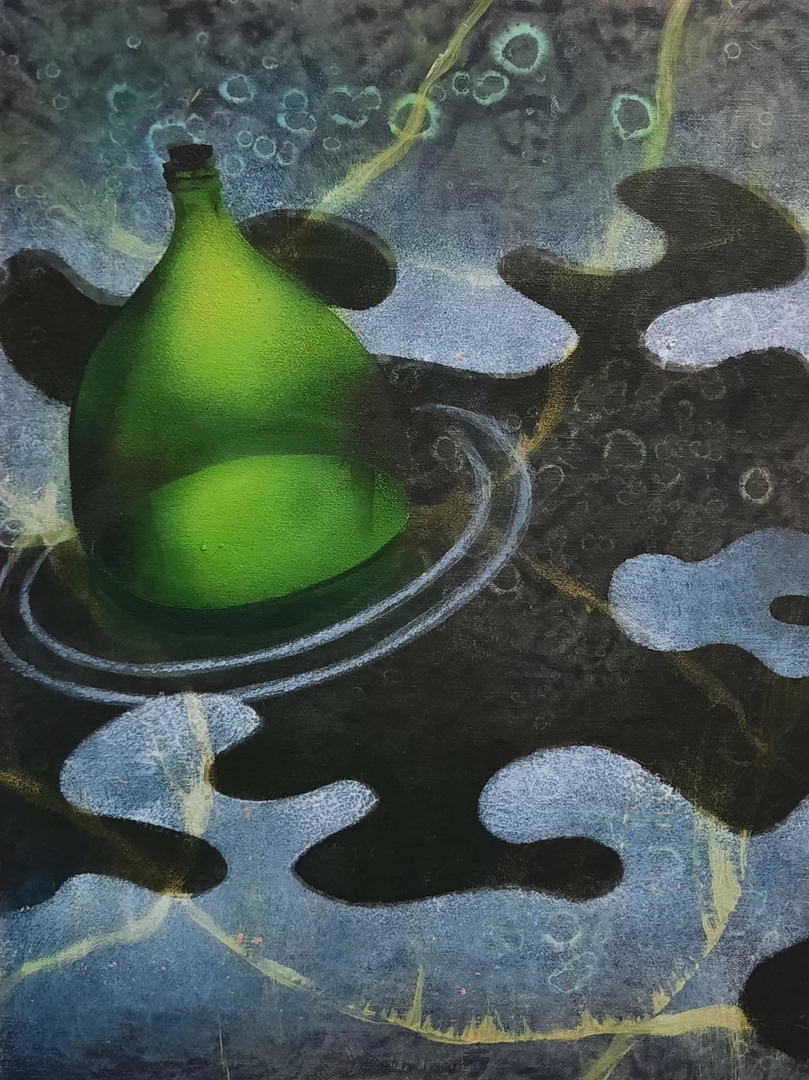
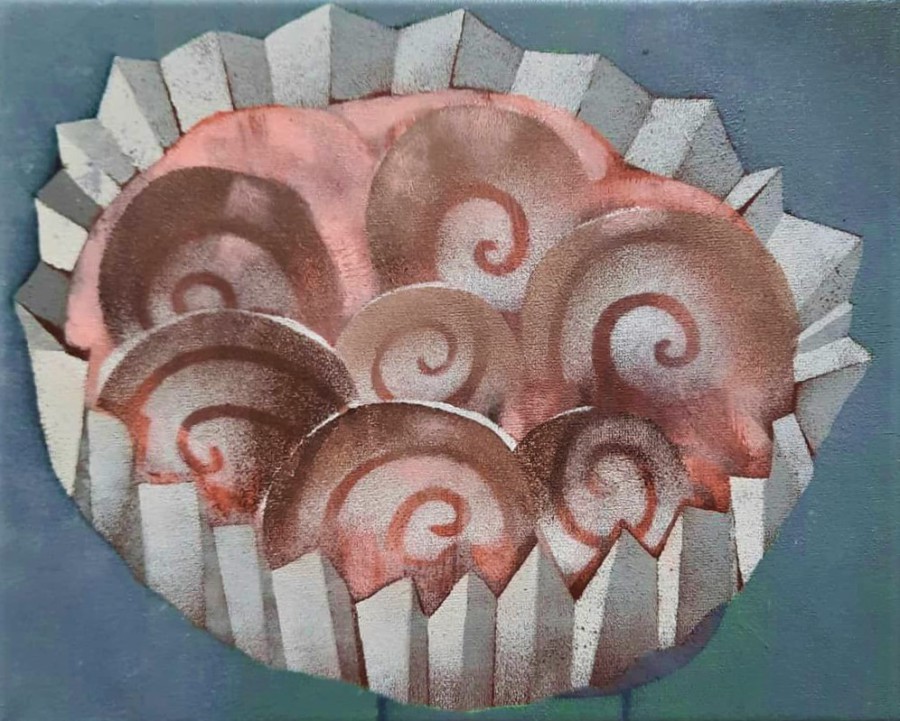
Felicitas Aga’s new paintings mark a distinct shift in her work.
The charged objects, cut shapes and surreal still-life arrangements of earlier series have not disappeared entirely, but here they have loosened.
The image has become more fluid, less dependent on the hard edge of the stencil, and more invested in the behaviour of paint itself.
These are paintings made from looking, but also from the act of letting looking dissolve - into reflection, water, light, repetition and drift.
The starting point is the canal: the view from living beside it, the daily presence of water, buildings, boats, weather and passing life.
But Aga does not treat the canal as a picturesque subject.
It becomes instead a structure for abstraction.
The long horizontal format of the larger works suggests a view extended over time rather than fixed in a single glance.
Water holds and distorts everything.
Forms slide, repeat, soften, break apart. A railing, a boat, a window, a shadow, a strip of reflected sky - each becomes less an object than a rhythm within the painting.
This is an important development in Aga’s practice.
Earlier works often gathered symbolic fragments into tightly staged compositions: flowers, moths, branches, fruit, domestic objects, theatrical forms and darkly comic still-life arrangements.
Those paintings were often built through sharper silhouettes and more defined graphic structures.
In this new body of work, the pictorial intelligence remains, but the means have changed.
The compositions feel less assembled than suspended.
Paint is allowed to pool, blur, stain and breathe.
Edges are less declarative.
The image seems to arrive through layers of adjustment, as if the paintings are finding their subjects by moving through them.
The canal gives Aga a new kind of motif: not a symbol, exactly, but a living surface.
It allows her to connect the external world to the internal logic of painting.
Water becomes a way to think about memory, perception and instability without making the work illustrative.
The titles - Urban Romance, Patterns, Autumn, The End, Troublemakers, WaterMusic - suggest narrative, atmosphere and incident, but the paintings themselves resist explanation.
They hold the everyday and make it strange, not by inventing fantasy, but by paying attention to how unstable ordinary seeing can be.
Greg Rook